
By Erik Reinthaler
WJI Intern
Shirley Abrahamson probably would have said people had talked about her long enough; her son, Daniel, told a crowd in the State Capitol rotunda on Friday that his mother was one of the least self-regarding people he knew. She would have wanted everyone to get back to work.
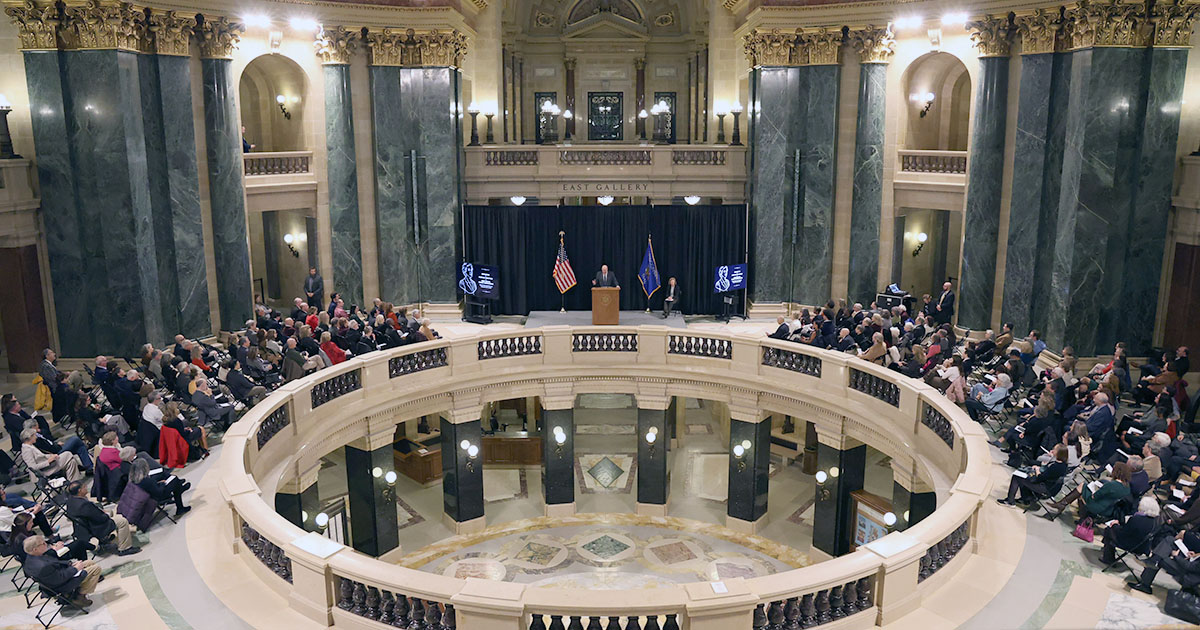
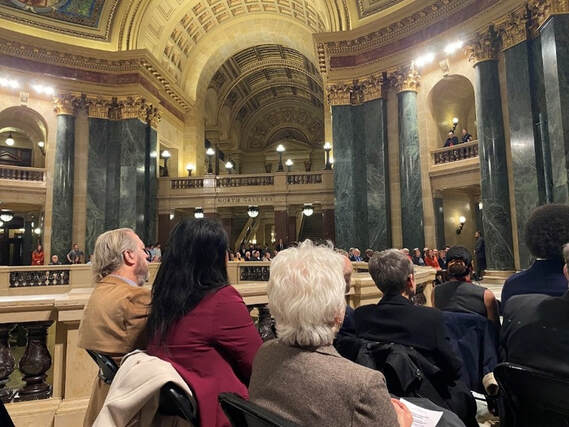
But on Friday, Nov. 6, about 200 people gathered to talk about her anyway, in a ceremony to dedicate a marble bust of Wisconsin’s first woman Supreme Court justice. They came with stories—some moving, some hilarious—about a woman who was larger than life, both on and off the bench.
Abrahamson joined the court in 1976 and served for 43 years, including 19 as chief justice. Former Gov. Jim Doyle called her one of Wisconsin’s greatest public citizens. He also had a fitting name for her: “the people’s justice.”
A long way from “unfit for female character”
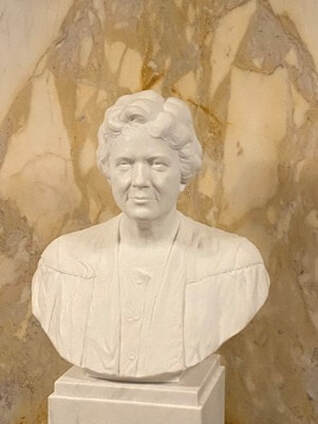
The new bust stands near the Supreme Court hearing room, alongside the marble likenesses of men who came before her. One is former Chief Justice Edward G. Ryan. In 1875, Ryan denied Lavinia Goodell permission to practice before the court, declaring law “unfit for female character.” Just over a century later, Abrahamson became the first woman to serve on the same court.
In a fitting bit of irony, Abrahamson’s bust is slightly larger than Ryan’s. Given his views on women in the law, it seems Abrahamson got the last laugh.
Chief Justice Jill Karofsky, the afternoon’s emcee, pointed out how much had changed. Six of Wisconsin’s seven Supreme Court justices are now women. Karofsky credited Abrahamson and other trailblazers for making that possible. She also joked that Abrahamson never let a slight height disadvantage get in her way and, in keeping the ceremony moving, asked everyone to proceed in an orderly fashion, just as Abrahamson would have wanted.
The dedication marked the first time a woman has been honored with a bust in the Supreme Court’s space—a welcome change in a place where history has long been carved mostly in men’s faces.
The way she made people feel
Doyle remembered Abrahamson as someone who knew people and genuinely liked them. He recalled a time she offered to bring chicken soup to his sick mother. Most people would picture a pot of homemade soup. Shirley arrived with a can of Campbell’s chicken noodle soup. She had promised chicken soup, after all. She had not promised to make it. Doyle said her gift for connecting with people was central to her success, including her four statewide election victories.
Former American Bar Association President Michelle Behnke recalled meeting Abrahamson when Behnke was a pregnant third-year law student assigned to escort the justice at a ceremony. She did not expect a conversation she would still be talking about decades later.
Abrahamson turned to her and said, “Don’t let anyone tell you that you can’t be a great lawyer and a great mom.” Behnke said she was dumbfounded. “A Wisconsin Supreme Court justice saw me,” she recalled. And when a justice of that court tells you something like that, she joked, “you don’t file a motion for reconsideration.”
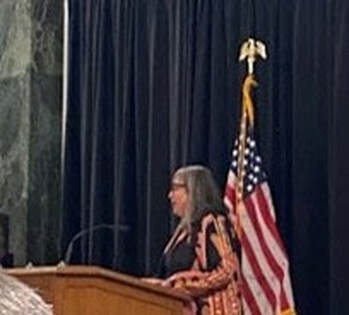
Amanda White Eagle spoke about another part of Abrahamson’s legacy: her commitment to Wisconsin’s Native communities and her respect for tribal sovereignty.
White Eagle also shared a personal memory of Abrahamson officiating her wedding at the Madison Children’s Museum. She recalled Abrahamson’s warmth and approachability, including her reaction to seeing a predominantly Native gathering at the ceremony.
That same respect carried into Abrahamson’s work on the bench. White Eagle described a justice who recognized tribal courts as coequal institutions, rather than inferior to the state courts. Abrahamson encouraged cooperation between the two judicial systems, emphasizing comity, mutual respect and tribal sovereignty.
Abrahamson also believed courts should be accessible to everyone. Programs she championed, including Court with Class and Justice on Wheels, brought students and community members into contact with the Supreme Court and took the court beyond Madison.
The Shirley her friends knew
Former Chief Justice Ann Walsh Bradley called Abrahamson the “conscience of the Wisconsin Supreme Court.” She recalled Ruth Bader Ginsburg’s extraordinary admiration for her. Then Bradley turned to the Shirley she knew away from the bench, the one who loved farmers markets, never learned to ride a bicycle, and could be unexpectedly competitive.
The two women, Bradley recalled, came from “different worlds, miles and years apart.” They had different backgrounds and did not always see things alike. But they respected those differences. “We played well together,” Bradley said. As it turned out, sometimes that was a dangerous invitation.
Bradley grew up playing pool. She was quick to admit she was by no means a great player, but she knew her way around a table well enough to challenge her friend. What she did not know was that Abrahamson had learned to play pool in law school.
Bradley found that out the hard way. Shirley, it turned out, was a pool shark.
Bradley told the story with good humor, recalling her own agony of defeat. It was a welcome reminder that the woman who could out-argue almost anyone on the bench could apparently wield a pool cue pretty well, too.

Abrahamson wrote 535 majority opinions and 493 dissents during her years on the court. Karofsky called the dissents “love letters to the future.” Turning to Daniel, she said, “I think you were your mom’s why.” Abrahamson wanted the world to be better for him, for her grandson Moses, and for everyone who came after them. Even when she did not have the votes, she kept writing. A dissent, for Abrahamson, was never the end of the argument.
Daniel Abrahamson thanked the people who made the sculpture possible, including stoneworkers at Quarra Stone in Sun Prairie and sculptor Martin Foot, artistic director of Quarra Italia in Pietrasanta, Tuscany. He described the rounds of drafting, editing, and reworking that went into the finished piece. That sounded about right for a justice who was never shy about revising a draft—or asking someone else to revise theirs.
The ceremony included a poetry reading, adding a more personal touch to an afternoon filled with stories, laughter, and fond memories of Abrahamson.
WJI previously profiled Abrahamson in an Unsung Heroes article, looking at the doors she opened for women in law and her efforts to bring the courts closer to the people they serve. The new bust gives visitors to the Wisconsin State Capitol a chance to encounter that history even if they never saw her on the bench.
Abrahamson spent much of her life making sure other people had a place in the law. On Friday, Wisconsin made a lasting place for her.