
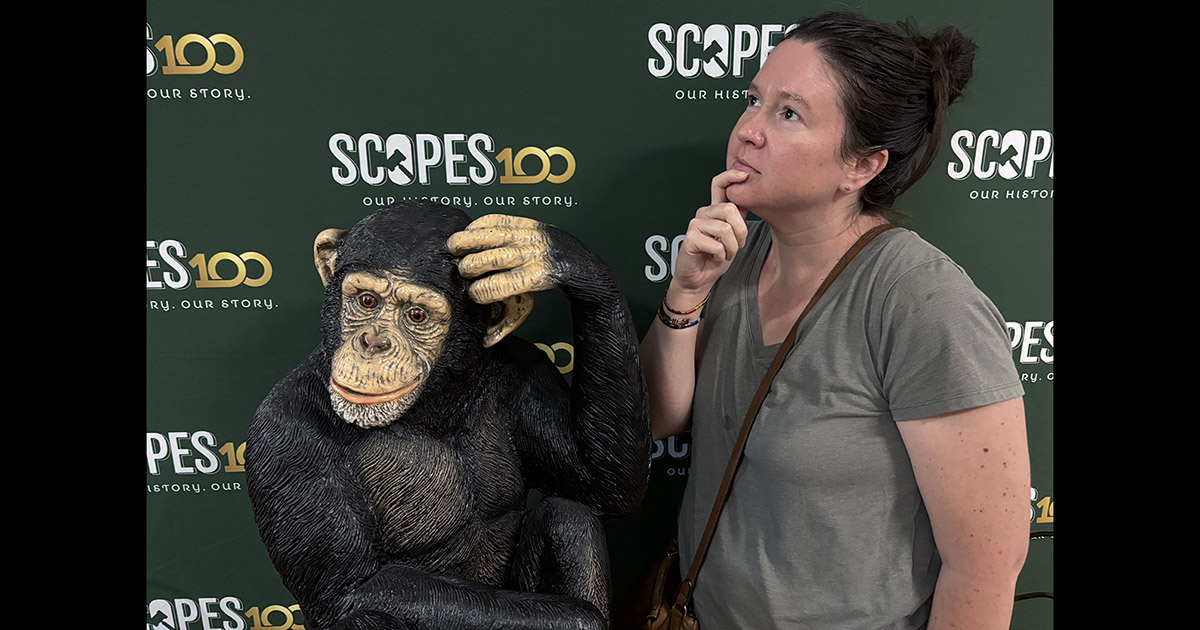
 Emily Kelchen took a moment to ponder the long-term impact of her own legal work during the 100th anniversary of the Scopes “Monkey” Trial in Dayton, Tennessee.
Photos: Emily Kelchen.
I’m a sucker for historic courthouses. So, when I realized I lived within easy driving distance of Dayton, Tennessee,
location of the Scopes “Monkey” Trial – and that 2025 was the 100th anniversary of the trial – I couldn’t wait to plan a visit.
The local community had events all year commemorating the centennial, but the highlight was to be a two-weekends-long festival on the courthouse lawn. I cleared my calendar and rewatched
Inherit the Wind in anticipation.
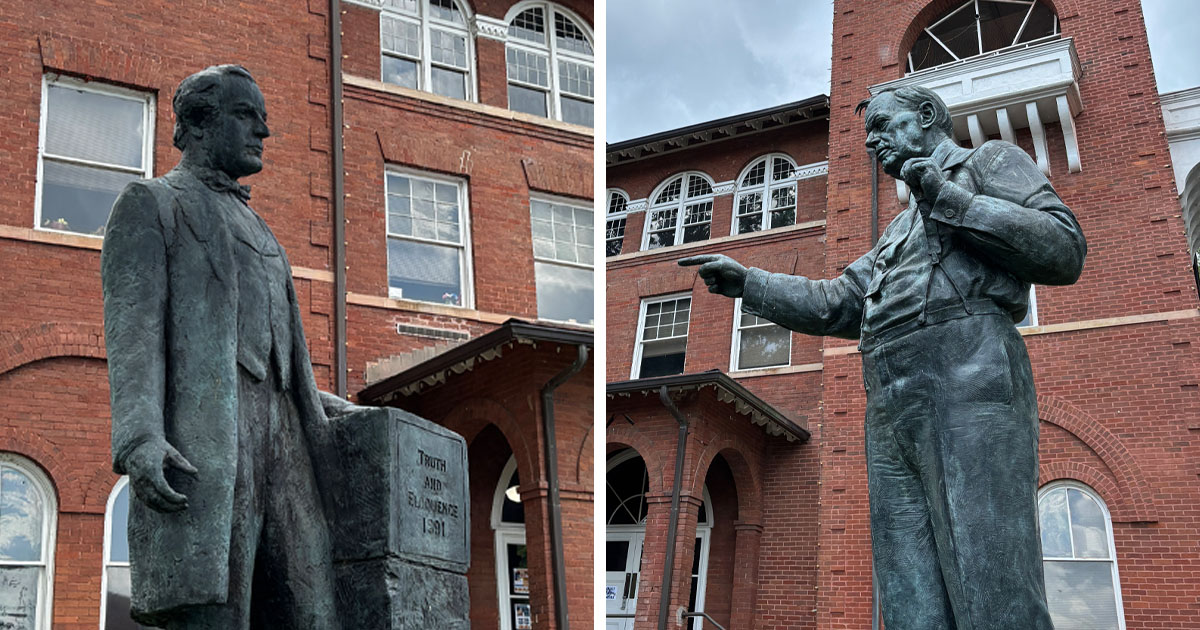 The statues of William Jennings Bryan (left) and Clarence Darrow (right) face each other in front of the Rhea County Courthouse in Dayton, Tennessee.
In the Shadow of Giants
If all you have time to do is drive by the Rhea County courthouse, do it. Like many of the same era it is a living monument to civic virtue. Its stately red brick facade reminds people of the serious business of upholding the rule of law.
Plaques around the building tell you the courthouse is listed on the National Register of Historic Places and has been designated a National Historic Landmark by the National Park Service.
But you can tell the community sees it as something more. It’s a gathering place. An outdoor community center whose tree-shaded lawn looks like it has played host to as many band concerts and carnivals as it has political speeches.
Overlooking all of this are towering statues of both William Jennings Bryan and Clarence Darrow. Bryan’s was donated in 2005 by nearby Bryan College, which was founded in his honor in 1930. Darrow’s was erected in 2017 by the Freedom from Religion Foundation. They face each other, locked in an eternal argument.
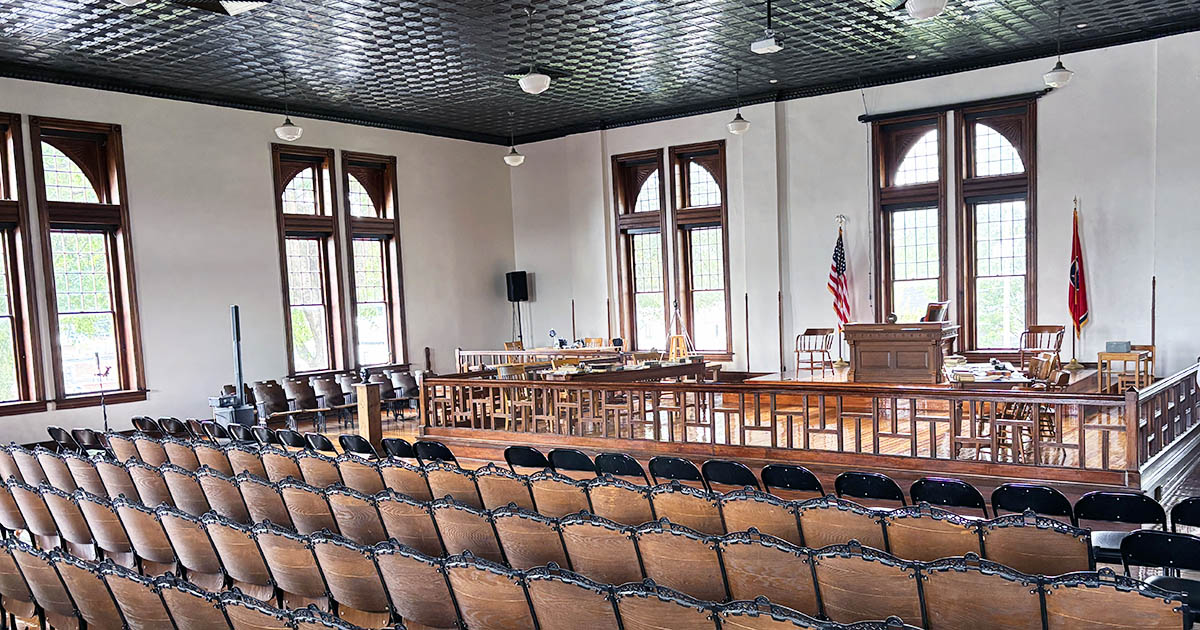 The inside of the courthouse is meticulously restored.
Stepping Back in Time
Inside, the second-floor courtroom has been meticulously restored to match the way it looked a century ago. Chairs for spectators are crammed into every possible space, and microphone cords snake across the gleaming floor. (They have, thankfully, added air conditioning.)
If I did not have two preschoolers in tow, I would have loved to stay for a production of “Destiny in Dayton.” The play, which is performed in the courtroom, is part history lesson, part propaganda – reenacting key moments of the trial while painting the town in a gentler light than
Inherit the Wind.
The courthouse basement is home to a
newly refurbished museum that is chock full of artifacts from the trial and local historical memorabilia.
The official circuit court minutes are displayed alongside a press pass, sock monkey, and sheet music for “Darwin’s Monkey Trot.” There’s a small cafe table representing the drugstore where townspeople dreamt up their lawsuit.
In one display case is the textbook Tennessee science teachers were required to use at the time. It describes the theory of evolution and diagrams the evolution of mammals from protozoa. Whether substitute biology teacher John Scopes taught this or not, the requirement that teachers use this text means educators across the state were in an impossible position: banned by the Butler Act from teaching evolution, but forced to use a textbook that embraces it (in part to bolster its support of eugenics).
Taken as a whole, you get a sense that the people of Dayton are inviting you in on a secret. They admit the charges brought against Scopes were ginned up in order to put their town on the map. (Hey it worked! You’re in their courthouse basement 100 years later!) As they celebrate the spectacle, they are also proud of the positive impact the trial had on the entire country’s education system – suggesting the trial inspired schools across the country to formalize and improve their science classes.
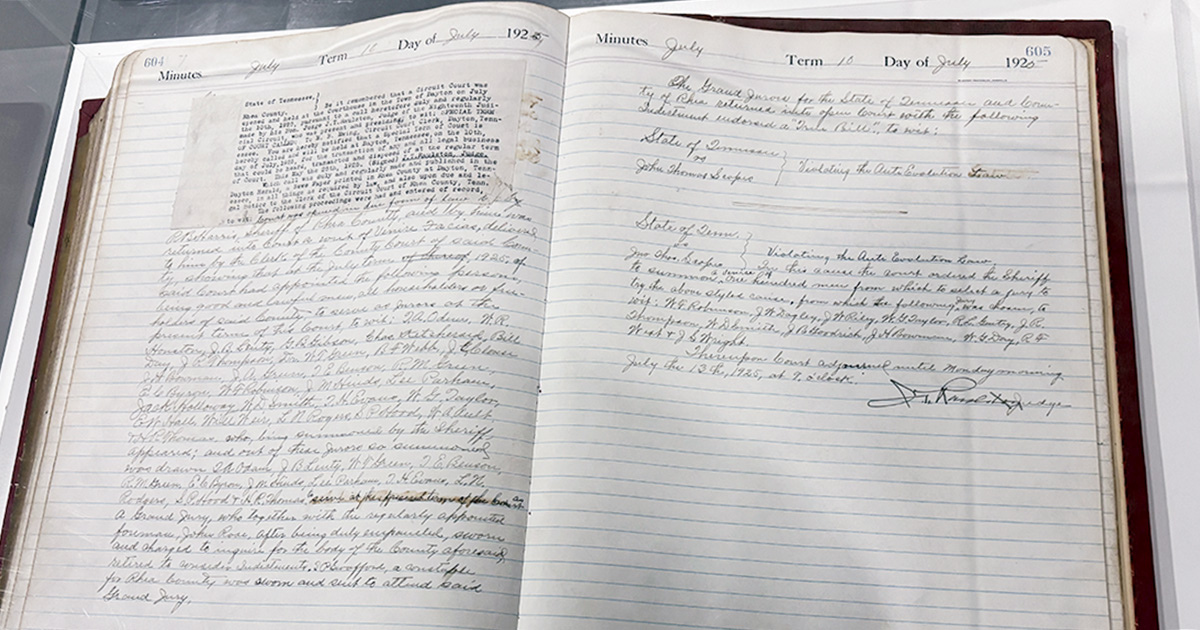 On display in the museum is the book containing the minutes of the trial on July 10, 1925.
Breaking Character
A festive atmosphere prevailed the day I visited. There were numerous pamphleteers around and a giant sign on the courthouse wall urging you to “Read your Bible!,” but scolds were far outnumbered by churches and civic organizations handing out free hotdogs and encouraging my kids to enjoy the dinosaur themed (!) bounce house. There was also a tribe with some tipis set up (the
Sequoyah Birthplace Museum is in nearby Vonore) and a farm hosting a petting zoo.
Without exception, the people were incredibly kind and welcoming. Eager to share their history and hospitality. Happy to prove their town hardly bears a passing resemblance to the close-minded backwater it was painted as by contemporary media and on the silver screen.
The people of Dayton have been telling their side of the story for 100 years. Letting us know they cooked up a test case. Inviting the world to their doorstep. Pushing back against mocking stereotypes.
It makes me wonder if people building modern day test cases have been to the Rhea County courthouse. Have they thought about how their story will be told? Considered the potential long-term impact of their case?
After all, “He that troubleth his own house shall inherit the wind.”
This article was originally published on the State Bar of Wisconsin’s
Nonresident Lawyers Blog. Visit the State Bar
Divisions page or the
Nonresident Lawyers Division webpage to learn more about division membership.