Wisconsin Republicans want you to join them in overreacting to Gov. Tony Evers’ use of executive partial veto power with a constitutional amendment.
Don’t fall for it.
This proposed constitutional amendment appears on the ballot as “Partial Veto Referendum—QUESTION 1.”
The referendum question asks voters the following: “Partial veto. Shall section 10 (1) (c) of article V of the constitution be amended to prohibit the governor, in exercising his or her partial veto authority, from creating or increasing or authorizing the creation or increase of any tax or fee?”
Historically, Wisconsin governors have had broad partial veto powers regarding appropriations bills compared to governors in other states.
Article V, § 10 of the Wisconsin Constitution currently allows the governor to modify an appropriations bill in part, provided the change does not create a new word by striking individual letters from words or create a new sentence by combining parts of two or more sentences.
The proposed amendment would add language to that provision, prohibiting any change by a governor that would create or increase, or authorize the creation or increase, of any tax or fee.
In the 2023-2025 biennial budget process, the Legislature passed funding provisions for the 2023-2024 and 2024-2025 school years. Evers then used his partial veto power to strike words, digits, and dashes to extend school districts’ ability to increase revenue limits from two years to 402 years (from 2023 through 2425).
Outraged, the Republican Legislature proposed this constitutional amendment in response.
In 2025, the Wisconsin Supreme Court upheld the veto. In a 4-3 decision, the court found that the partial veto limitations as currently written apply to words and letters, but not digits. Further, the partial veto satisfied the veto power principles discussed in prior case law.
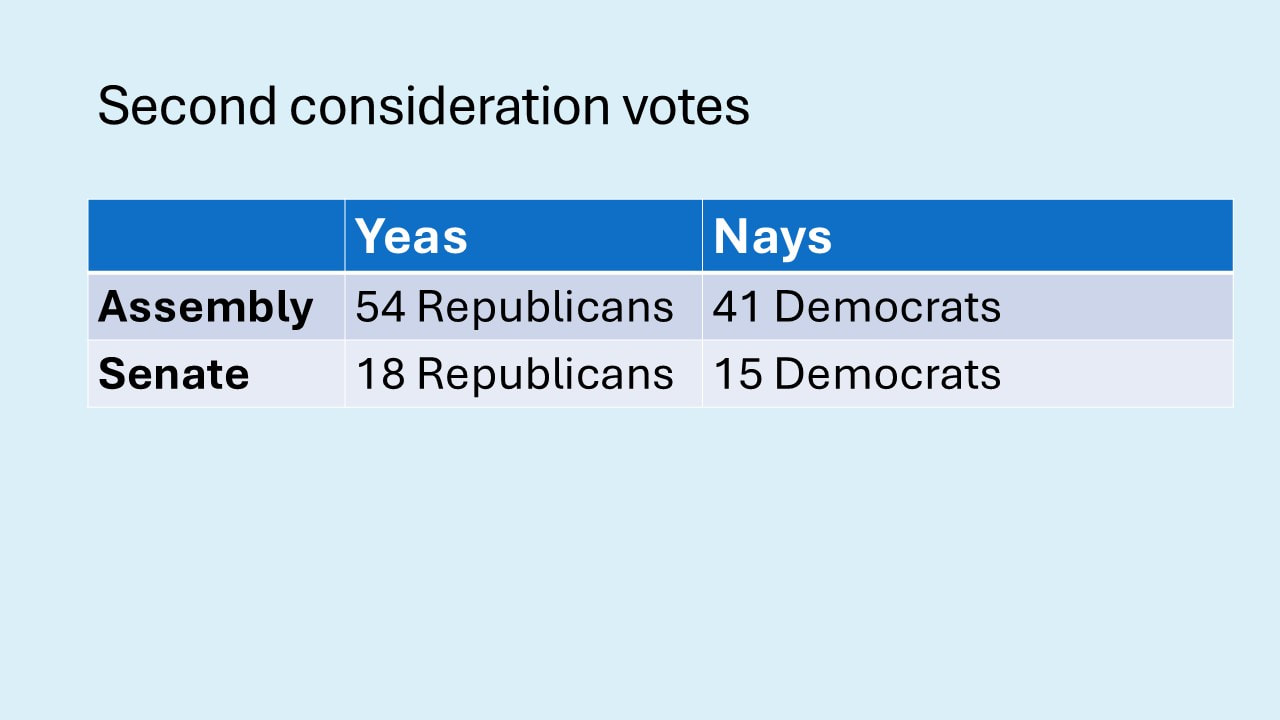
As noted by the court, the Legislature could have overridden the partial veto with a supermajority vote. The Senate voted to override, but the Assembly did not.
The Legislature has had the power to pass subsequent laws repealing the 400-year revenue limit extension, but it has not been successful. A bill this past legislative term would have eliminated the yearly school revenue limit increases after 2026. The bill passed both chambers, but Evers vetoed it and the Legislature again failed to override his veto.
Republican lawmakers are now pursuing a parallel route of amending the constitution, arguing that a proper balance of power between Legislature and governor requires this constitutional change.
Rep. Amanda Nedweski (R-Pleasant Prairie) submitted written testimony when the proposed amendment passed through the Legislature on second consideration. (A proposed constitutional amendment must pass through the Legislature twice, in consecutive legislative sessions.) She wrote that the proposed amendment “restores the proper balance between the branches of government, and ensures taxpayers are protected from runaway tax increases in the future.”
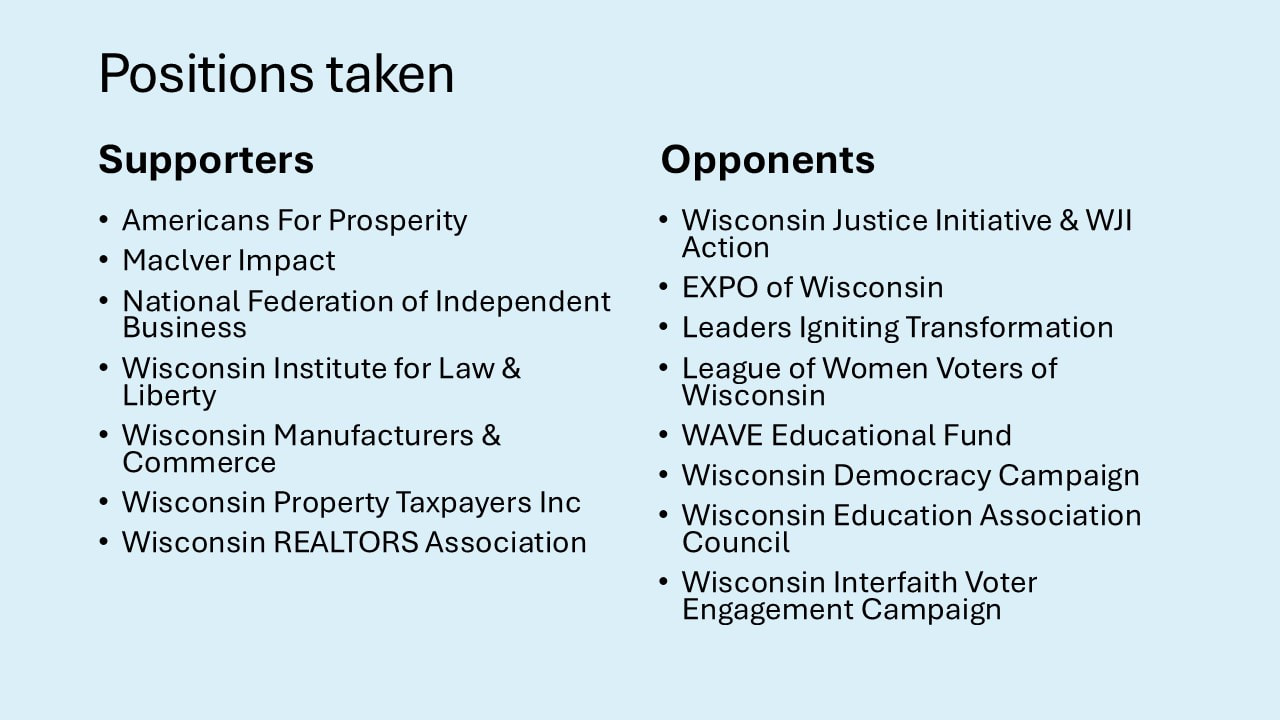
Sen. Chris Kapenga (R-Delafield) wrote that Evers’ 400-year extension “was a deeply egregious move,” which the amendment aims to stop from happening again.
Wisconsin Manufacturers and Commerce wrote that Evers’ 400-year extension “is making Wisconsin unaffordable” and the amendment will “keep Wisconsin free from tax-and fee-increasing kings.”
If passed, the amendment will affect governors of any party.
Courts would ultimately have to resolve any ambiguities in the provision’s scope or application.
Wisconsin Justice Initiative and WJI Action oppose the amendment. The constitution already includes procedures for the Legislature to override a veto or pass subsequent legislation. We should avoid filling our constitution—a source of individual rights and the basis of our state government—with provisions that side-step usual government processes.
In essence, the proposed amendment is an extension of a political fight between this Democratic governor and the Republican-led Legislature. The state constitution should not be a battlefield for political fights between the Legislature and governor when the parties differ.
Political disagreements should not shift the balance of power between the Legislature and governor that has existed for almost 100 years as backlash to one veto.
The governor’s partial veto power was added to the Wisconsin Constitution by amendment in 1930, and this is not the first time voters have been asked to restrict the provision after a governor’s use of it.
After Republican Gov. Tommy Thomspon used the partial veto to strike individual letters in words to create new words (nicknamed the “Vanna White veto”), voters approved a letter-striking restriction in 1990. After Democratic Gov. Jim Doyle used fragments from multiple sentences to create a new sentence (nicknamed the “Frankenstein veto”), voters approved another partial veto restriction in 2008.
But we do not need to react with a narrow constitutional amendment each time the partial veto is used by a governor to the Legislature’s displeasure.