
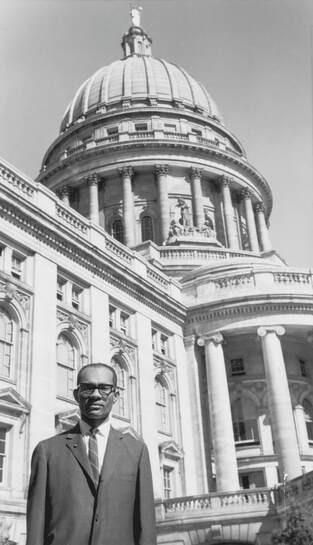
 Lloyd Barbee at the Wisconsin Capitol in August 1964. Photograph courtesy of the Wisconsin Historical Society. WHS Image 26539.
Three words—long used as the sign-off before his signature—sum up Lloyd Barbee’s goal throughout his life.
Justice for All.
Best known for his efforts to desegregate Milwaukee’s public schools, Barbee fought for justice on other fronts, too. He was an activist, attorney and state legislator, pushing for equal rights as human rights, arguing for fair housing and employment, women’s rights, gay rights, prison reform and much more.
Fellow members of the state Assembly soon called him “the outrageous Mr. Barbee.”
For Barbee, it would have been outrageous not to fight for justice.
“Lloyd Barbee, a lawyer, a legislator, and an influential voice for the National Association for the Advancement of Colored People (NAACP), led the modern civil rights movement in Wisconsin for many years,” according to a Wisconsin Lawyer article in 2004. It was written by Joseph A. Ranney, of Marquette Law School and its Adrian Schoone Fellow for the Study of Wisconsin Legal Institutions, and Maxine Aldridge White, now retired as chief judge for the state Court of Appeals.
“Barbee’s gentle manner concealed an iron determination that served him and his cause well,” they continued. “Barbee occupies a unique place in Wisconsin legal history and civil rights history.”
Others have agreed.
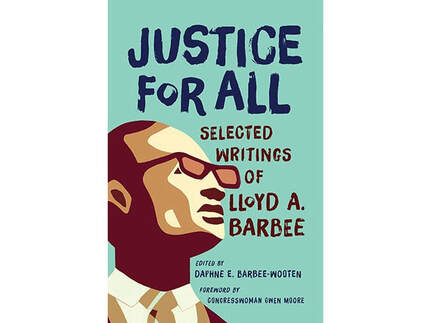
“I don’t think Wisconsin has ever had a legislator as prolific and profound as Lloyd Barbee,” wrote U.S. Rep. Gwen Moore in the forward to Justice for All/Selected Writings of Lloyd A. Barbee. The book was edited by his daughter Daphne E. Barbee-Wooten, a civil rights lawyer, and published by the Wisconsin Historical Society Press in 2017.
“He was a pioneering black legislator, a trailblazer, and a true coalition builder. … The truth is that we could really use a Lloyd Barbee today. But I like to think we can still learn from him, and can still fight like he did,” Moore wrote.
|
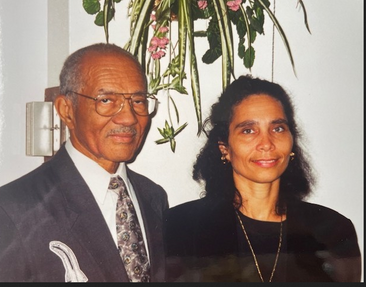
Lloyd Barbee and his daughter, Daphne Barbee-Wooten, at an awards ceremony in 1996. Photograph courtesy of Daphne Barbee-Wooten.
|
Barbee’s story began in Memphis, Tennessee, as the third son of Earnest and Adelina Barbee. His father was first a carpenter and later a paperhanger and housepainter. His mother died of childbirth complications in 1926, only months after Lloyd’s birth in 1925. As a Black woman in the South, she did not have access to hospital care.
His father would later tell how baby Lloyd was born with “a veil over his head,” said Barbee’s daughter, speaking in an interview with Wisconsin Justice Initiative. The rare occurrence of the amniotic sack on an infant’s body was taken as a sign that the child was destined to be an important person.
In his later years, Barbee recalled the first time he heard the word justice and asking his father what it meant. He was then about 10 years old.
“He told me it was what a person deserved or what his due was,” Barbee wrote. “It might be hard sometimes but also fair. That word and concept stuck with me.”
Young Barbee joined the NAACP at 12, attending segregated schools in the Jim Crow South.
He served in the Navy during World War II, from 1943 to 1946. He next earned an undergraduate degree at LeMoyne College, a historically Black college in Memphis.
In 1949, Barbee came to Wisconsin to study law at the University of Wisconsin-Madison. It was not the positive integrated experience he expected.
Instead, he found what he later called the northern version of “moderate white” racism.
“He faced racial discrimination at the Law School, by professors and fellow classmates, and dropped-out after his first year. Soon after, however, he re-enrolled and completed his degree in 1956,” according to an article by Christopher Lehman, writing for The Educator Collaborative Community.
In those early years, as he struggled to earn a living, Barbee also worked as an attorney for the state’s Department of Labor, and on state and Madison human rights commissions.
Early activism in Wisconsin
While at the law school, Barbee began serving as president of the NAACP’s Madison chapter. In 1961, he began leading the state NAACP and was soon making headlines.
“In 1961 he organized his first sit-in, a 13-day, round-the-clock vigil at the State Capitol rotunda in support of fair housing and equal opportunity legislation in Madison—the first demonstration of this type in the nation,” according to the Ranney-White article.
Other leaders—notably state Assembly Rep. Isaac Coggs, Roy Wilkins, who led the national NAACP, and NAACP general counsel Robert Carter, who worked with Thurgood Marshall—encouraged Barbee to move to Milwaukee.
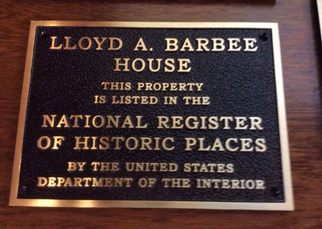
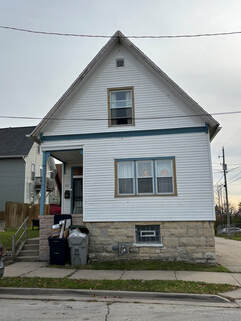 Barbee’s house at 321 E. Meinecke Ave., Milwaukee, now on the National Register of Historic Places. Photograph by Margo Kirchner in November 2025.
Barbee and others were aghast that a Polk County lake was named “N—– Heel Lake.” They won a partial victory with the U.S. Department of the Interior and its Geological Survey, getting the name changed to Freedom Lake. The name did not immediately change on state maps.
While traveling to Beloit, Barbee and a cousin were refused service at a chili restaurant. A police officer eating at the counter said he did not know about the Wisconsin Accommodation Law and the district attorney did not pursue charges.
When he wrote in protest of a Black face performance at Whitewater College, the College Board of Regents “declared that free speech was at issue and [that the] NAACP was asking for censorship, so on went the show,” Barbee recalled in Justice for All. He led a picket line the night of the performance, attracting often negative coverage, but the minstrel show was not held again.
In 1968, he represented Black students at UW-Oshkosh who had been dismissed from the university after protesting for African American history courses. Barbee won a court order for their readmission on the grounds that their due process rights had been violated.
Yet another campaign brought quick results.
“We discovered that a district office of the Wisconsin Employment Service was utilizing an unmarked box on its application form as a code to designate the race of applicants and that they were accepting job orders from employers who stated racial preferences—they even solicited such preferences—all in violation of Wisconsin and federal law,” he wrote. “We succeeded in halting this practice within a week’s time at the local office and witnessed measures to end this practice throughout the state.”
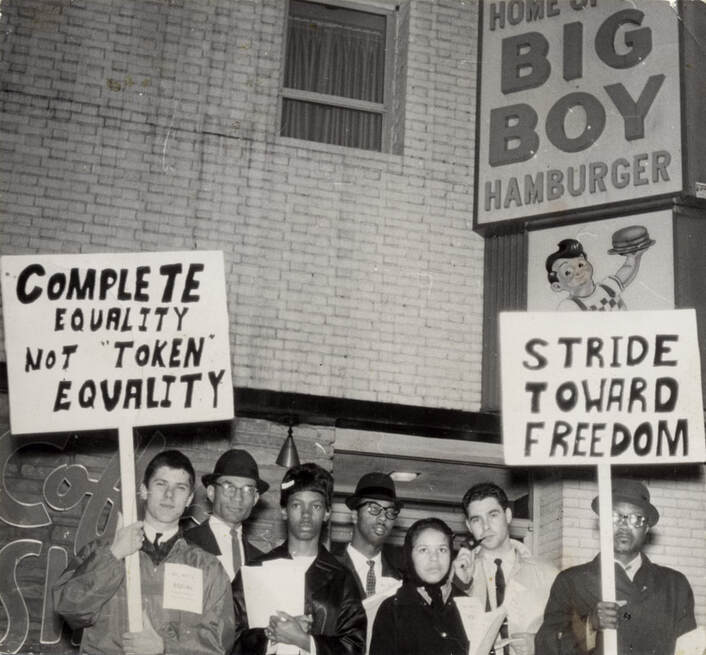
One effort was thwarted in those early years, only to make headlines nearly 60 years later. A University of Wisconsin press release announced the news:
Law School alum Lloyd Barbee’s pursuit of justice reemerges in a long-lost film, now found
“Lloyd Barbee ’56 was just a few years out of law school and the president of the local NAACP branch when he and two friends hatched a plan to use hidden cameras to document and expose housing discrimination in Madison,” it began.
Barbee and Stuart Hanisch, with the UW Extension Bureau of Audio Visual Information, pitched the plan, and it was approved by the Board of Regents. Money for the project, including from the NAACP, was donated to the university.
Their 1962 film documented incidents of discrimination as would-be tenants and buyers, Black and white, applied for housing before fair housing laws were passed. Black applicants were told that housing was no longer available. White applicants found willing landlords and listings. Some said the obvious out loud:
“We don’t feel we can rent to colored people.”
“I don’t want to have trouble with my neighbors.”
“I can’t let you have it. Not in this neighborhood.”
Those situations were not a revelation to people of color. An initial screening for university officials, however, brought a different reaction. The film was ordered banned and restricted, ostensibly over privacy concerns, something that prompted yet more controversy, protests and another team’s effort to reenact the documentary. Filmmaker Hanisch resigned from the university in protest.
After Justice for All was published, Barbee-Wooten gave a talk at the university and was asked whatever happened to the documentary. She had tried to locate it without success.
“I heard it was destroyed,” Barbee-Wooten said.
Others, however, were curious and wanted to know more. It was found by Cat Phan, digital and media archivist with the university archives, stored away and held under restriction.
“I didn’t understand why this was restricted,” Phan told Wisconsin Justice Initiative. “We looked at all the documents in the archives and ran it by the legal department. With secret cameras and hidden recording devices, they were capturing live interactions about housing discrimination. It was a pretty special film.”
Ultimately, the decision was made to lift the restricted status. Barbee’s daughter was thrilled to see where the film had been kept for all those years.
“When we got down to the stacks, the box had skull and cross bones on it,” she said. The word RESTRICTED was repeatedly stamped in red on the boxes.
Kacie Lucchini Butcher, director of the university’s Center for Public History, was also involved, including with research and facilitating a restored version of the film.
It made its premiere in 2021 during an online event sponsored by PBS Wisconsin, the Public History Project and the UW Archives. The film and discussion about it can be seen here.
Barbee understood what the film meant: “Before the film was shot and suppressed, it was the rule, rather than the exception, for public officials, real estate dealers, and the news media to declare that Wisconsin had no problems whatever with racial discrimination in housing.”
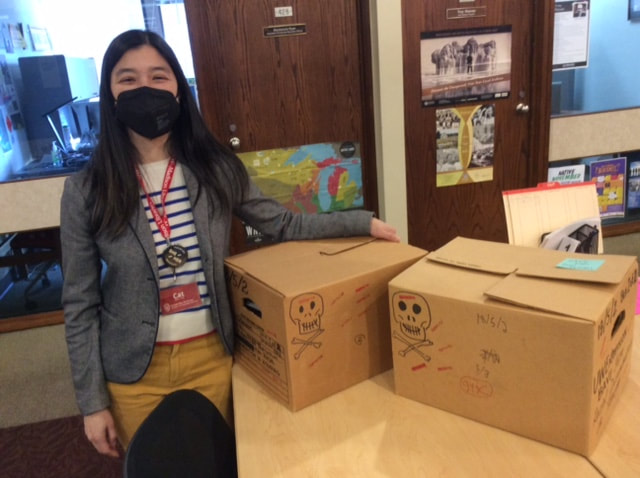
Cat Phan, with the UW-Madison Archives, found the boxes of film from the 1962 documentary. The word “RESTRICTED” was repeatedly stamped on the boxes. Photograph courtesy of Daphne Barbee-Wooten.
|
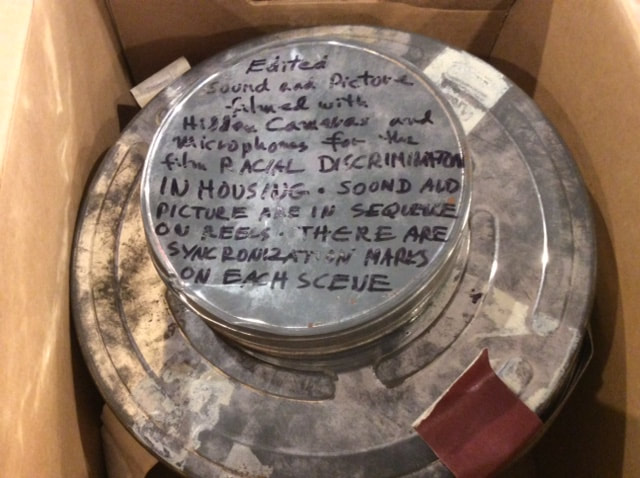
Some of the film canisters found inside the boxes. Photograph courtesy of Daphne Barbee-Wooten
|
For Barbee, the issue of fair housing was intricately entwined with the need to integrate public schools. Milwaukee based its system on so-called neighborhood schools, but given the deeply segregated neighborhoods, the schools were deeply segregated, too.
In 1958, years after the Brown v. Board of Education decision, Milwaukee began a program it called “intact busing.” Black students and teachers were bussed from overcrowded neighborhood schools to white schools—but remained segregated in separate classrooms and sometimes even at lunch, school assemblies and recess.
In the early 1960s, Barbee led the NAACP’s challenge to the district to do better on integration, proposing a plan for selective bussing and a more equal racial balance in the schools. District leaders did not change direction. That led the NAACP to create what the community called Freedom Schools.
By 1964, Barbee was organizing and leading an alliance of activists—the Milwaukee United School Integration Committee, known as MUSIC—demanding the end of de facto segregation.
“If the Brown decision means anything,” declared Barbee, “it means that school segregation is unconstitutional wherever it exists, north or south.”
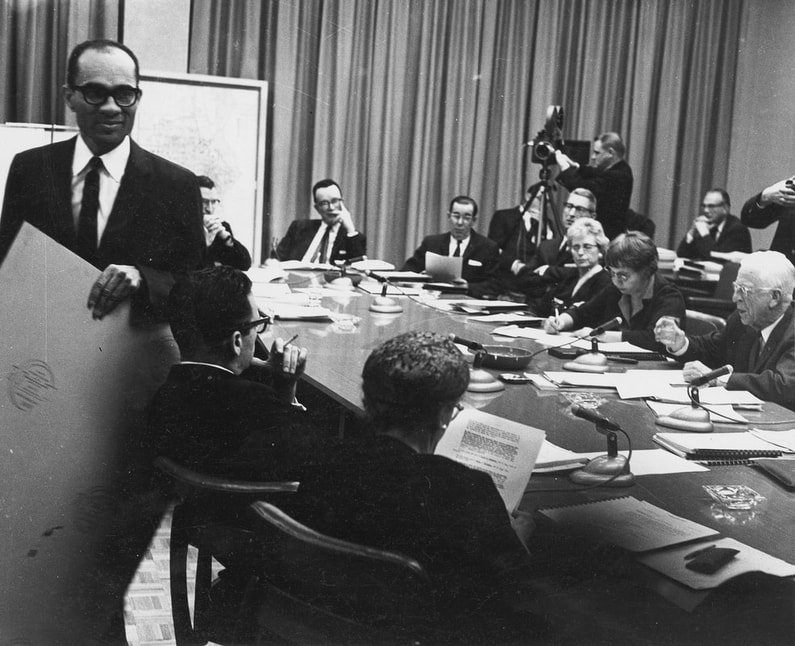
“From 1965 to 1976,” it continued, “Barbee spent thousands of hours on the case, often working alone against a battery of Milwaukee Public School lawyers.” After 10 years, another attorney, Irvin Charne, was appointed to assist Barbee in the case.
The activist years were filled with both exhilarating times—meeting people like world champion boxer Muhammad Ali and Black Panthers co-founders Huey P. Newton and Bobby Seale—and distressing times, Barbee-Wooten said.
“How many teenage girls got to meet Huey P. Newton?” she said. “I was starstruck.”
The family also experienced the violence of rocks thrown, broken windows, and a burglary in which books were ransacked and family pictures stolen.
“We did get death threats a lot,” said Barbee’s daughter. She was maybe 12, playing dolls at home with a friend, when the phone rang. A man’s voice spewed ugly words.
“He said he was coming over in 15 minutes to kill us,” she said.
She and her friend hid under a bed.
“My father said when people are threatened, they will make threats, but don’t be afraid,” Barbee-Wooten said. “As long as there was bigotry, he’d call it out. He was not afraid. It was almost as though that was his destiny.”
Legal victories and realities
“Finally, in January of 1976, federal Judge John Reynolds ruled that Milwaukee Public Schools were indeed segregated unlawfully, prompting the Wisconsin Legislature to enact a school integration program,” the historical society article stated. “Although Barbee won the case in 1976, he spent the next several years dealing with appeals, new trials, and work to enact a viable plan to desegregate the school system. Though not perfect, the court decision began to address schooling issues in Milwaukee.”
School authorities “engage in practices with the intent and for the purpose of creating and maintaining a segregated school system, and . . . such practices had the effect of causing current conditions of racial imbalance in the Milwaukee Public Schools,” Reynolds wrote.
“The Constitution does not guarantee one a quality education; it guarantees one an equal education, and the law in this country is that a segregated education that is mandated by school authorities is inherently unequal,” he said in his ruling.
In 1978, he reaffirmed that decision.
Barbee’s efforts next involved working with MPS to forge a plan for integration.
“The whole system should be ordered to desegregate, root and branch,” Barbee said. “If we don’t do that, then we will have engaged in a paper victory.”
“The plan finally approved by Reynolds called for limited busing to achieve greater racial balance in Milwaukee schools, funds for specialty schools to induce white suburban students to transfer to MPS,” according to the Ranney-White article.
Barbee, who also served in the state Assembly during the long legal battle, convinced his fellow legislators to support what became the “Chapter 220” program. The integration program provided funds for suburban districts that accepted Black students from Milwaukee. Those early efforts found some success, with a substantial number of MPS schools becoming more racially balanced.
That did not last.
“White flight, the school choice program, and divisions in the black community dealt setbacks to his vision of a fully integrated society,” Ranney and White wrote in 2004.
Under Gov. Scott Walker’s administration, the Chapter 220 program was phased out. The open enrollment program, which does not provide transportation, and vouchers have further complicated integration efforts.
The current numbers reflect the stark reality of what is now considered hypersegregation. When Reynolds issued his ruling, the Milwaukee district had about 60% white students and about 34% Black students, The Milwaukee Journal reported in 1976. A state report for the 2024-25 school year found the district’s student population to be about 50% Black, 25% Hispanic or Latino, 10% Asian and 9% white.
In his later years, Barbee acknowledged that Milwaukee schools were again segregated.
The one positive: Contemporary issues do not have the stain of government-sponsored segregation.
“I think my father had to file the lawsuit, because otherwise change would not have happened,” Barbee-Wooten said.
“It accomplished a lot, not just for Milwaukee but for other school districts. It established that not just de jure segregation but de facto segregation was against the law,” she said, distinguishing between what was caused by laws and what was actually happening in practice. “He would be disappointed that not enough people care but it’s there on the books.”
“I am not discouraged,” Barbee said. “I have seen more difficult times. We are not as well off as we could be, but we are better off than we were.”
Barbee was elected as a state representative in 1964, filling the vacancy left by Isaac Coggs.
A couple bits of trivia are worth considering about his time in public office. It was not the first time Barbee went to work at the Capitol building. He earlier worked there as a janitor while a law student at UW.
In addition, “he represented comedian Dick Gregory when he was arrested while protesting segregated schools and charged with disorderly conduct,” wrote Barbee-Wooten in the introduction to Justice for All. “My father had also been arrested for protesting segregated schools. Since he was a legislator at the time, he had immunity and could not be prosecuted.”
Barbee served until 1977, the only African American legislator in the state Legislature for much of that time. In addition to his better-known civil rights efforts, the “outrageous Mr. Barbee” also introduced progressive bills to legalize marijuana, prostitution and abortion, disarm police officers, tax churches, and even decriminalize hitchhiking. He repeatedly introduced gay rights legislation and welcomed the support of new state Rep. David Clarenbach. In 1982, Wisconsin passed the first such legislation in the country.
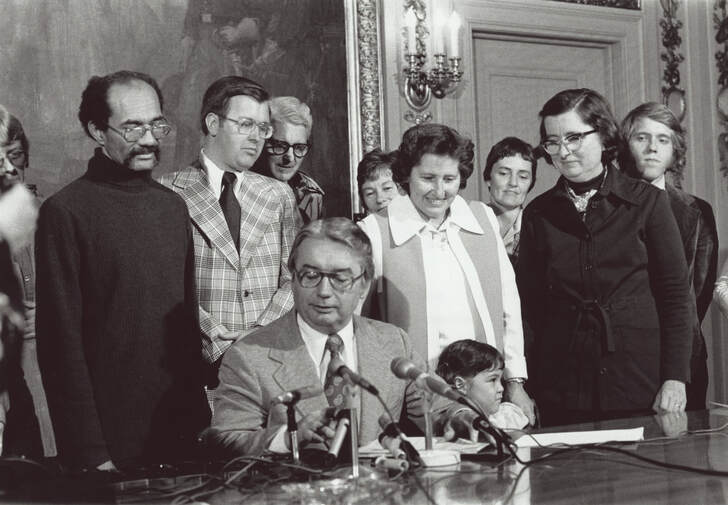
Barbee went on to teach at the University of Wisconsin-Milwaukee’s Africology Department from 1978 to 2000.
He continued practicing law and activism until his death in 2002. He was 77.
The Lloyd Barbee Montessori School was named in honor of the man who filed the famous lawsuit against the school district. The Lloyd A. Barbee House—the family home, a gathering site for activists and long his legal office—is now on the National Register of Historic Places and an official city and state landmark.
What would he be doing today?
“Well, he’d be 101,” his daughter said, with a laugh. “I think he’d be right out there, speaking if he could, marching and protesting, if he could.
“I think he’d be extremely disappointed today in the U.S. isolation and the way the Constitution is being degraded, the administration going back to segregation, firing Black generals and women generals, erasing names from monuments. And in Congress. Congress has been asleep, walking zombies.
“But he would be very happy to see, with the recent elections, five liberal women justices on the Wisconsin Supreme Court,” she said. “He’d be thrilled about that.”
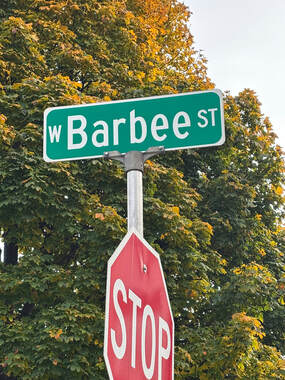
Lloyd Barbee is honored with a Milwaukee street named for him. Photograph by Margo Kirchner in November 2025.
|
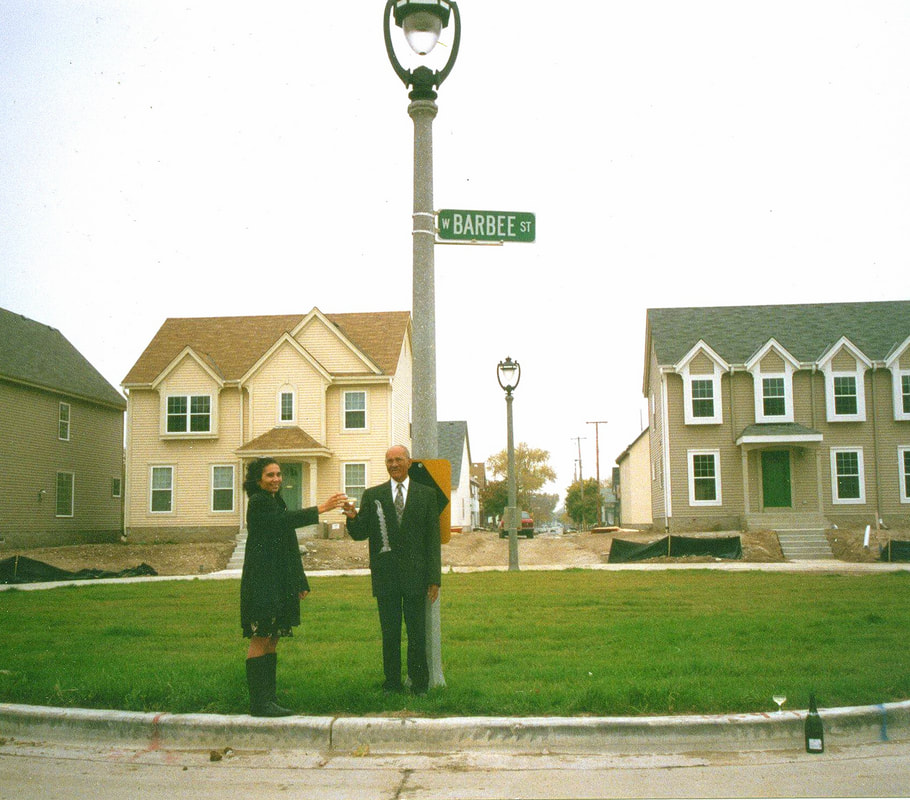
Lloyd Barbee and Daphne Barbee-Wooten at the sign in the circle on W. Barbee St. in 1996. Photograph courtesy of Daphne Barbee-Wooten.
|
This project is supported by grants from

|

|