There’s some consensus among lawyers that ethics rules already cover the responsible use of generative artificial intelligence in court submissions, but a recent petition to the Wisconsin Supreme Court is asking for more.
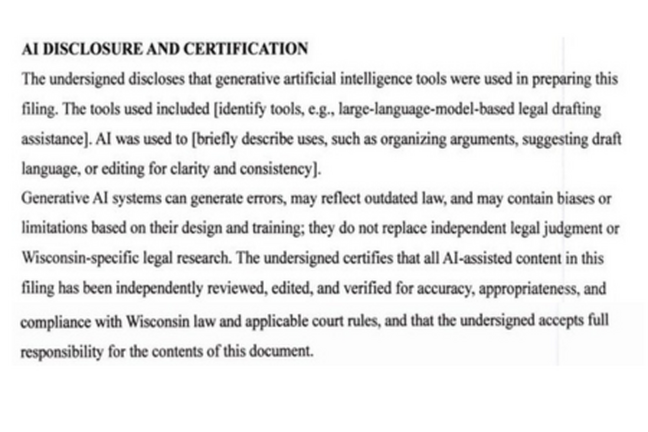
The rule change petition seeks to mandate explicit disclosure to the court and disclosure by the court when generative AI is used in the preparation of everything from court filings to opinions.
The petition was filed by frequent pro se (self-represented) litigant Jay Stone.
Stone’s petition “has a lot of the hallmarks of a ChatGPT document itself,” attorney Stacie Rosenzweig recently remarked to Wisconsin Justice Initiative. Rosenzweig, a partner at the law firm Halling & Cayo, specializes in legal ethics and professional responsibility.
She said by email that that while it would be unusual for Stone’s petition to be adopted by the Supreme Court as is, the petition “could spur some further discussion or an invitation from the Court for comments.”
Rosenzweig discussed “a bit of debate” in ethics circles about the necessity of additional guidance.
According to personal injury attorney Ann Jacobs, Wisconsin’s code of legal ethics should be sufficient to cover the landscape regarding AI use. Jacobs recently gave a continuing legal education presentation on the topic.
She told WJI that rules regarding confidentiality, candor, and competence are sufficient to protect against the dangers of generative AI. The trouble, though, she said, is that those rules are not always followed.
For example, earlier this year Kenosha County District Attorney Xavier Solis found himself in hot water after failing to disclose the use of AI in a brief he submitted to a court. The brief included hallucinated (made-up or fake) citations and ultimately resulted in sanctions.
In late 2025, a misattributed citation by Wisconsin Supreme Court Justice Annette K. Zeigler in a dissent regarding congressional redistricting had some speculating about the use of AI.
“It looks and quacks like an AI generated error,” said Jacobs.
And there are now a handful of databases tracking legal decisions in which generative AI produced hallucinated content. One demonstrates that internationally, United States judges and arbitrators are by far the most frequent offenders in this area, with 871 offenses. Canada (139 offenses) and Australia (73 offenses) are next in line.
The most prolific of the watchdog projects is run by Damian Charlotin, a senior research fellow at HEC Paris, a top ranking European business school. Another newer and less robust Charlotin data base tracks legal cases in which generative AI was used as evidence to argue or prove a point.
But the use of AI itself isn’t the issue. Instead, the problem is the technology’s propensity for inaccuracy.
Courts across the United States have sanctioned, fined, and otherwise provided extreme consequences for attorney misuse of generative AI, primarily viewing them as ethics violations.
In Wisconsin, Supreme Court Rule 20:1.1 governs attorney competence about technology: “(A) lawyer should keep abreast of changes in the law and its practice, including the benefits and risks associated with relevant technology,” the rule says.
Other rules regarding client confidentiality and candor to the court supplement that rule. For example, using AI may involve an attorney providing sensitive client information to an unsecure system. That implicates a client’s confidentiality and triggers a lawyer’s obligation to communicate with the client, Jacobs said.
Rule 20:3.3 requires candor to the tribunal. “You cannot have read a fake case, which means your work has not been thorough,” said Jacobs.
In July 2024, the American Bar Association issued a formal opinion on attorney use of generative AI. It cited existing ethical obligations “such as those relating to confidentiality, communication with a client, meritorious claims and contentions, candor toward the tribunal, supervisory responsibilities regarding others in the law office using the technology and those outside the law office providing (generative AI) services and charging reasonable fees.”
But what’s happening in practice is nevertheless evolving, shaped by local rules and sanctions when things go awry.
Currently, Kenosha County (where petitioner Stone lives) and Waukesha County are the only jurisdictions in the state with local rules requiring disclosure to the court regarding AI use.
Complicating the issue is little specific instruction for litigants who represent themselves—which generative AI may encourage more people to do.
Some, like Stone, believe that upfront disclosure of generative AI use should be a requirement moving forward.
No stranger to litigation, Stone has a handful of what he calls “election integrity” cases pending in the Court of Appeals and lower courts. He used AI in many of them.
“It’s a tremendous tool,” Stone said on a call with WJI. “But it can be very harmful.”
Throughout his litigation, Stone observed there was no AI disclosure requirement for pro se litigants. Holding pro se litigants to the same standards and expectations of attorneys is based on caselaw.
He feels disclosure is the right way to go. “I believe in full transparency,” he said.
The current rule change petition would require a self-represented litigant who uses a generative AI tool in preparing any filing or other written work product submitted to a state tribunal to independently review and verify the accuracy of all statements of fact and law and the authenticity of all citations before filing. The pro se litigant would have to disclose such use in the same manner as an attorney.
The proposed rule emphasizes that existing ethical duties of competence, confidentiality, candor, and supervisory responsibility apply fully to the use of AI tools, Stone wrote in the petition.
For Rosenzweig, a rule applicable to pro se litigants makes more sense as a rule of civil procedure.
“Perhaps disclosure rules, more generally, and applied across the board, are a good stopgap,” Rosenzweig said. “(T)hey’ll remind people (lay and lawyer) of their obligations.”
But we may have already entered a world where most people use AI without even knowing it.
“I think eventually we won’t need disclosure,” said Rosenzweig. “Either AI will fizzle as a fad, or will be integrated into so much that affirmative disclosures would be as useless as disclosing whether you used Google or a cloud server.”
The Supreme Court has not yet taken any action on Stone’s petition, known as petition 26-02.