Wisconsin legislators are asking voters to approve a constitutional amendment purportedly about religious liberty, but which many religiously leaders themselves are not supporting.
The proposed amendment seeks to get around a governor’s veto and may reduce government flexibility in responding to emergencies.
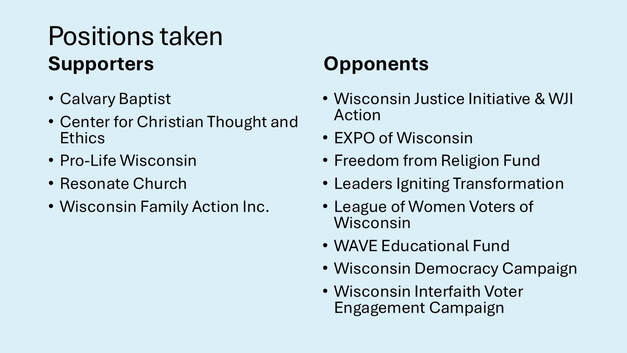
Wisconsin Justice Initiative and Wisconsin Justice Initiative Action advocate a “no” vote.
This proposed constitutional amendment appears on the ballot as “Freedom to Gather in Places of Worship During an Emergency Referendum—QUESTION 2.”
The ballot question asks voters: “Shall section 18 of article I of the constitution, which deals with religious liberty, be amended to prohibit the state or a political subdivision of the state from ordering the closure of, or forbidding gatherings in, places of worship in response to a state of emergency, including a public health emergency?”
Article 1, § 18 of the Wisconsin Constitution addresses Wisconsinites’ religious liberties. It currently provides in full: “The right of every person to worship Almighty God according to the dictates of conscience shall never be infringed; nor shall any person be compelled to attend, erect or support any place of worship, or to maintain any ministry, without consent; nor shall any control of, or interference with, the rights of conscience be permitted, or any preference be given by law to any religious establishments or modes of worship; nor shall any money be drawn from the treasury for the benefit of religious societies, or religious or theological seminaries.”
The proposed amendment would add the following language before the period of the current provision: “; nor shall the state or a political subdivision of the state order the closure of or forbid gatherings in places of worship in response to a state of emergency at the national, state, or local level, including an emergency related to public health”.
The amendment thus would create a new limitation on any state governmental official or entity—such as the governor or local health departments—to close places of worship or forbid gatherings in them because of any state of emergency.
Although public health emergencies are expressly named, the provision would apply more broadly to any type of emergency—including flooding, tornadoes, or civil unrest. The provision contains no exception for the severity of the emergency.
If passed, the amendment would not prevent congregations from voluntarily closing during a state of emergency.
The proposed amendment is a reaction to Gov. Tony Evers’ orders in early 2020 regarding the COVID-19 pandemic, prohibiting any large gatherings. Evers’ orders prohibited any public or private gathering of 10 people or more in an enclosed space, including at schools, theaters, museums, and arenas.
Questions exist about whether the proposed amendment would be legal and how it would be interpreted. Courts would ultimately have to resolve any ambiguities or issues with the proposed provision’s scope or application.
For instance, could places of worship legally remain open even when comparable secular gathering places are closed? That could be seen as giving preferences to religious organizations over secular ones, when just two clauses before the new language, § 18 states that no preference can be given to religious establishments or modes of worship.
Could government officials still impose lesser restrictions, such as capacity or distancing requirements, even though closure could not be ordered?
Of note, legislators attempted without success to pass a similar provision as a statute. Although the bill was approved in both the Assembly and Senate, Evers vetoed it in 2021.
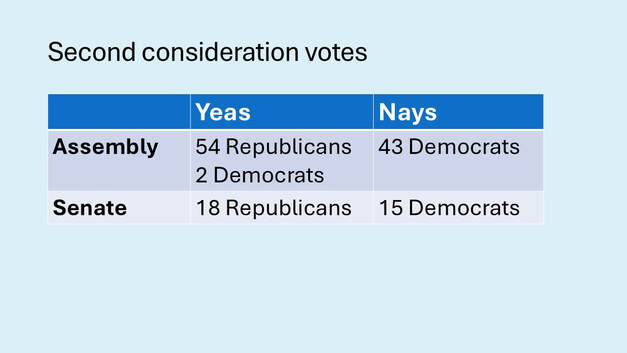
Amendment sponsors Rep. Ron Tusler (R-Harrison) and Sen. Cory Tomczyk (R-Mosinee) submitted written testimony in favor of the resolution when it passed through the Legislature on second consideration. (A proposed constitutional amendment must pass through the Legislature twice, in consecutive legislative sessions. It then goes to voters.)
Tusler argued that houses of worship were shuttered in 2020 while liquor stores, bars, and casinos were deemed essential and remained open. He pointed to spiritual communities being “lifelines” and a source of stability and connection during times of crisis.
Tomcyzk pointed to a West Bend church service in April 2020 being interrupted by law enforcement. He said he found it “disturbing and unacceptable” that the service was stopped because “the government decided that a virus was more important than the constitutional rights of Americans.”
Wisconsin Family Action wrote in testimony that the right to worship freely “should never be subject to the force of government control based on the whim of a state of emergency.” It continued: “It doesn’t take much imagination to foresee scenarios where the government could declare an emergency for any kind of reason thereby granting itself the ability to infringe upon our right to worship.”
Many Wisconsin religious leaders and organizations, though, do not appear to be exhorting their congregations and members to approve the amendment.
The Wisconsin Catholic Conference, which responds to issues common to the five Catholic dioceses in the state, registered as neutral when the proposed amendment was first introduced in the Legislature, and it remains neutral. Executive Director David Earleywine told WJI that the organization discussed possible changes with the resolution’s authors when the provision was first introduced, but the suggestions were not included in the passed version.
Earleywine said on behalf of the conference that “Freedom to gather for worship is only one important aspect of religious liberty and religious conduct, both of which extend beyond the four walls of a house of worship.”
The Wisconsin Council of Churches has taken no position on the proposed amendment. And when registering its neutral position with the Legislature when the amendment was considered the second time, the council questioned the amendment’s wisdom and asked why existing constitutional language is not sufficient.
“Making good choices about what to do in a public emergency requires closely attending to the particular circumstances at hand and using the best information and understanding available at the time. Trying to define the options in advance, without any clear idea of exactly what we could be facing in the future, is unwise,” the council wrote.
The Evangelical Lutheran Church in America (ELCA) also has stayed neutral. The Lutheran Office for Public Policy in Wisconsin (LOPPW), though, issued a voter guide that examines all three Nov. 3 ballot questions through the lens of ELCA social teachings. Regarding this proposed amendment, the voter guide says “ELCA social teaching emphasizes that God intends humans to work for the ‘common good’ and says that the government is serving God’s purposes of justice and good order when it cares for the most vulnerable in society,” adding that being responsible and loving includes doing no harm and promoting others’ well-being.
Kacy Kostiuk, director of the LOPPW, told WJI that the voter guide is meant to help Lutherans understand how this proposed amendment relates to their church’s social teachings. “The guide examines both the amendment and the church’s social teaching and concludes that the amendment is not consistent with ELCA commitments to the common good, care for our neighbors, health as a shared endeavor, and responsibility for a just society,” she said.
The Freedom from Religion Foundation provided WJI with the following statement from copresident Annie Laurie Gaylor: “Religious beliefs can never justify endangering the public. Viruses don’t distinguish between crowds singing in a church or at a bar. Why would any church or place of worship want to endanger worshipers and, by extension, the public, by knowingly flouting emergency orders?”
At least one organization outside Wisconsin supports the Legislature. The Center for Christian Thought and Ethics, a religious thinktank out of Florida, says on its website the proposed amendment “keeps the state in its lane and not in our pews.”
Wisconsin Justice Initiative and WJI Action oppose the amendment. Constitutional amendments should be reserved for matters that are truly necessary, after long-term implications have been considered. If passed, this proposed amendment could reduce the flexibility of government officials to respond to the emergencies we can’t even predict at this time—whether health crises and pandemics, floods, fires, blizzards, or myriad others.
That several religious leaders and significant religious organizations have not called for and are not supporting this amendment—taking a neutral position or even advocating for a “no”—is telling. The Legislature has proposed an amendment regarding religious worship that several religious leaders and organizations are not endorsing.
Further, the proposed amendment is an extension of a political fight between a legislature of one party and a governor of the other. In response to a veto, legislators can override with a two-thirds majority. If they cannot override, that is how the process goes. As with the proposed partial veto amendment, there is no need to react with a constitutional amendment each time a governor vetoes a bill. If the public does not like the result of failed legislation, the solution is to elect different legislators or governor, not to amend the state constitution.