
Statistics distributed at a “state of the court” presentation on Thursday show that Milwaukee County Circuit Court’s projected felony and criminal traffic case filing numbers for 2026 are noticeably higher than in recent years, while misdemeanor case filing numbers increased only slightly.
Based on the number of filings through August 31, felony case filings in 2026 are projected at 6,255, almost 600 more than in 2025 and 1,000 more than in pre-pandemic 2019. Criminal traffic cases are projected at 1,593, almost 300 higher than in 2025 and double 2024, though pre-pandemic 2019 numbers exceeded that tally significantly, with 2,287 cases filed that year.
Chief Judge Carl Ashley discussed the statistics briefly at his yearly court update to the Milwaukee Bar Association during a luncheon at the Wisconsin Club. Demand on the courts is rising, he said.
He noted that a high number of trials—600 per year, a 30% increase since 2019—is causing pressure in the trial courts. Criminal cases are driving the trial numbers.
Misdemeanors, though, are a “bright spot,” said Ashley. Filings remained generally level compared to 2025, and the median length of time from filing to closure dropped from 240 days in 2021 to 162 days in 2026.

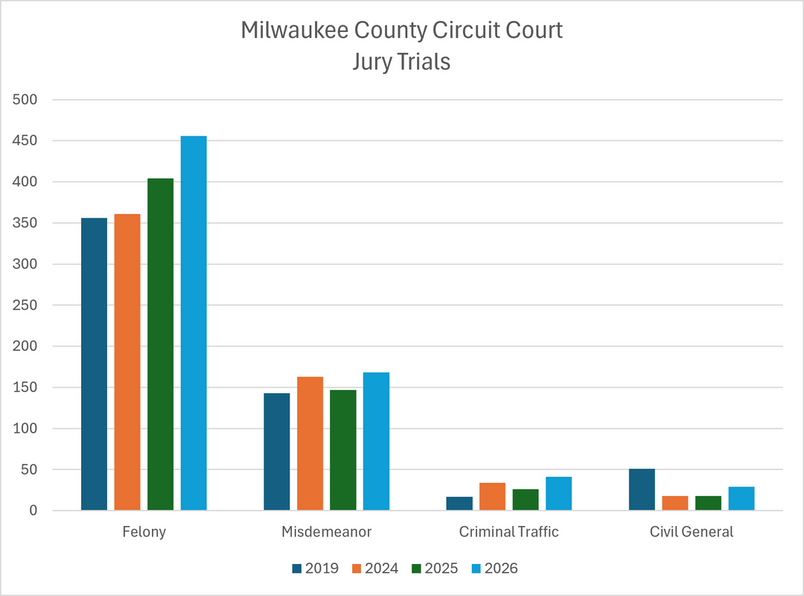
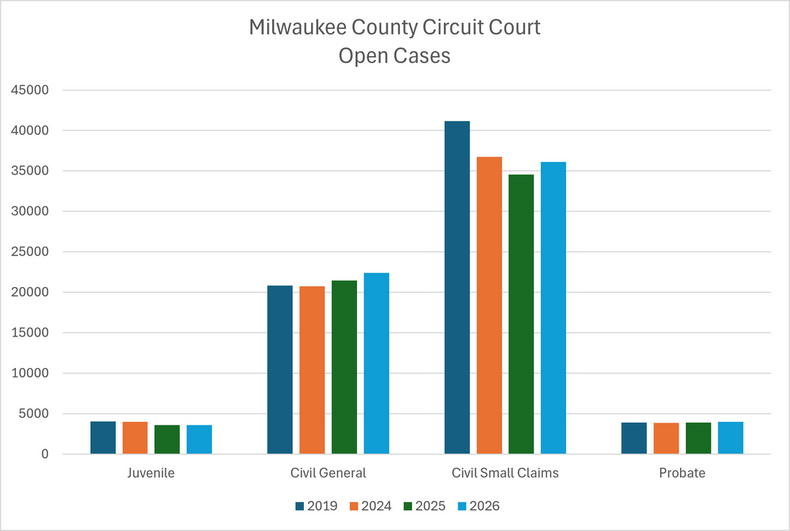
Noncriminal case filing numbers were not provided. Instead, statitistics showed the numbers of open cases and closures. At the end of 2025, there were 21,439 open civil cases (excluding small claims and probate), and the court had closed 21,844 cases. The projected 2026 civil numbers are 22,392 open cases and 22,154 closures.
Ashley discussed good and bad news for the court, then turned to the significant courthouse complex building project, which involves replacement of the 100-year-old Public Safety Building.
Ashley’s good news:
- Regarding bailiff staffing, “today is substantially better” than in recent prior years, when insufficient bailiff staffing by Milwaukee County deputy sheriffs caused some courts to go without. Ashley said there were still some hiccups, “but we’re a far cry from the issues we used to deal with.”
- Milwaukee County courtrooms are in “good shape” regarding the availability of court reporters, another area of need in prior years.
Concerns for the Milwaukee County Circuit Court:
- A lack of interpreters is a significant problem. Milwaukee County courts use interpreters in more than 65 languages, but he primary issue is a dearth of Spanish interpreters, Ashley said. Unmet interpreter demands are not limited to Milwaukee County, but are nationwide, he said. Ashley noted discussions between his court and Milwaukee Area Technical College to provide training courses for those interested in becoming an interpreter, so they can pass the difficult qualification tests. He said he was “optimistic about that.”
- The unavailability of defense attorneys continues to be an issue in criminal cases.
Ashley touched briefly on a topic frequently raised by attorneys: their credentials for entering the courthouse without waiting in line at security screening posts. Attorneys are able to obtain identification cards from the court allowing them to bypass security lines, so they are not late for hearings. Courthouse officials have discussed changing the courthouse entrance procedures and systems to improve security. Access to the courthouse is a concern for attorneys and has been a frequent discussion item for the Milwaukee Bar Association’s courts committee.
Ashley said the new security procedures and system have not rolled out yet, “but (are) coming.”
Ashley discussed evolving views by judges on how to address mental health and trauma in the courts. For example, rather than taking litigants who have outbursts in court into custody, judges can work to understand the underlying reasons for the behavior (sometimes caused by conditions in the courtroom) and ease them.
Milwaukee County Circuit Court created a mental health treatment docket under Judge Mark Sanders. Ashley said Sanders has transferred to probate court, so mental health treatment court ideas now can be extended to civil cases. Judge Nidhi Kashyap currently presides over the criminal mental health treatment docket.
Ashley discussed benefits of the Investing in Justice: Courthouse Complex project, which will replace the Public Safety Building with a facility built to improve security by separating the flow of judges and jurors, litigants, and the public. Other improvements include better access for disabled persons, energy efficiency and savings, spaces for attorneys to meet with clients, space for members of the district attorney’s office and victims’ program, and dedicated locations for problem-solving courts such as treatment courts, Ashley said.
Ashley and Aaron Hertzberg, who spoke at WJI’s July 15 Salon, have spearheaded the project.
County supervisors stripped out a $45 million portion for a new entrance on the east side of the historic courthouse, but Ashley suggested the change will not impact gains from the remainder of the project.
The Public Safety Building is set to be demolished in 2028, with construction of the new building occurring from 2029 to 2032, Ashley said.
Criminal courts located in the Public Safety Building will need to move in to the historic courthouse. Renovations in the historic courthouse begin in 2027 to retrofit courtrooms and other spaces for criminal court proceedings.
During these years, judges will increase their use of virtual hearings to accommodate the increase in personnel and activity in the historic courthouse. “It’s going to be cozy,” Ashley said. “We appreciate your patience.”